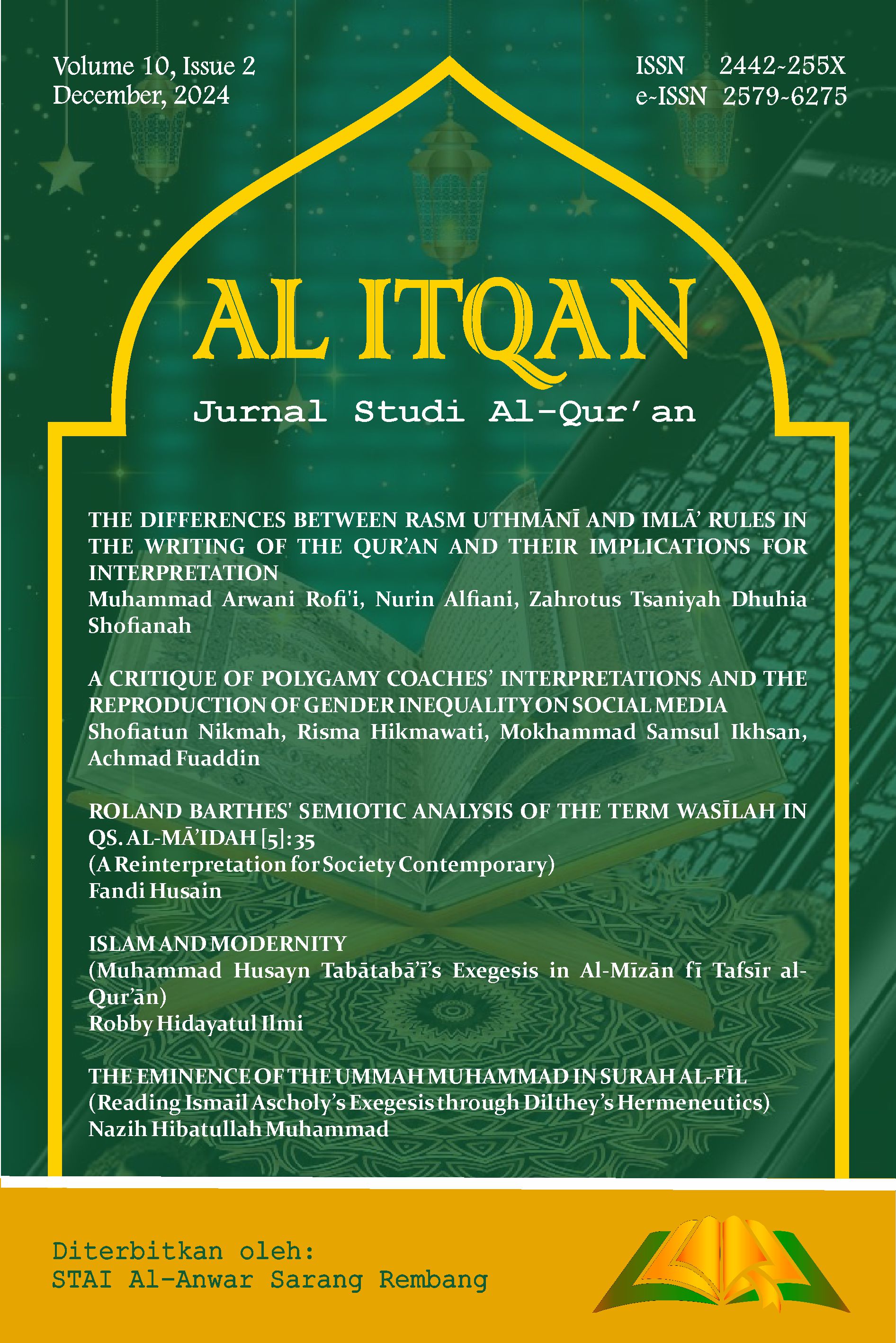
ISLAM AND MODERNITY
Muhammad Ḥusayn Ṭabāṭabāʾī’s Exegesis in Al-Mīzān fī Tafsīr al-Qurʾān
DOI:
https://doi.org/10.47454/alitqan.v10i2.1181Keywords:
modernity; rationalism; modernist tafsir; ṬabāṭabāʾīAbstract
This article aims to examine Muhammad Ḥusain Ṭabāṭabāʾī’s reaction to modernity in Tafsīr al-Mīzān fī Tafsīr al-Qurʾān, contextualizing it within the wider discourse of Muslim discussions on rationality, empiricism, and secularization. The research utilizes a qualitative, library-based methodology centered on intellectual history. The principal source, al-Mīzān, is analyzed thematically and later organized according to Abdullah Saeed’s paradigm of “modernist tafsir” to discern patterns of adoption, negotiation, and critique of modernity. The results suggest that Ṭabāṭabāʾī embodies a dual stance. He incorporates certain contemporary features, like a critical perspective on tradition, rational and linguistic methodologies, inter-sectarian openness, and a pronounced focus on interpreting the Qurʾān through the Qurʾān (tafsīr al-Qurʾān bi al-Qurʾān). Conversely, he rigorously challenges scientific reductionism and the subjugation of revelation to Western empirical epistemology. Rooted on the philosophy of al-ḥikmah al-mutaʿāliyah, he safeguards the metaphysical and mystical aspects of the Qurʾān while remaining receptive to rational discourse with contemporary ideas. This paper advances the field by illustrating that answers to modernity within the Shiʿi tradition are diverse, presenting a form of critical synthesis between rationality and transcendence. In this regard, Ṭabāṭabāʾī illustrates the potential for a Qurʾānic interpretive epistemology that is both contemporary and critically defiant of Western intellectual dominance.
Downloads
References
Algar, Hamid. “ʿAllāma Sayyid Muḥammad Ḥusayn Ṭabāṭabāʾī: Philosopher, Exegete, and Gnostic.” Journal of Islamic Studies 17, no. 3 (2006): 326–51. https://doi.org/10.1093/jis/etl002.
Ali, Jan A. “Introduction to Special Issue: Islamic Revivalism and Social Transformation in the Modern World.” Religions 14, no. 7 (2023): 899. https://doi.org/10.3390/rel14070899.
Bowen, Glenn A. “Document Analysis as a Qualitative Research Method.” Qualitative research journal 9, no. 2 (2009): 27–40. https://doi.org/10.3316/QRJ0902027.
Creswell, John W., dan J. David Creswell. Research Design: Qualitative, Quantitative, and Mixed Methods Approaches. 4 ed. SAGE Publications, 2017.
Gösken, Urs. “Perception of Western Modernity from the Gaze of Ṣadraism: Muḥammad Ḥusayn Ṭabāṭabā’ī’s and Murtaḍā Muṭahharī’s Critique of Modern Western Philosophy.” International Journal of Persian Literature 1, no. 1 (2016): 142–63. https://doi.org/10.5325/intejperslite.1.1.0142.
Haj, Samira. Reconfiguring Islamic Tradition: Reform, Rationality, and Modernity. Stanford University Press, 2008.
Hardiman, F. Budi. Filsafat Modern: dari Machiavelli sampai Nietzsche. Gramedia Pustaka Utama, 2007.
Jahanbakhsh, Forough. Islam, Democracy and Religious Modernism in Iran, 1953-2000: From Bāzargān to Soroush. BRILL, 2001.
Kersten, Carool. “Islam, Cultural Hybridity and Cosmopolitanism: New Muslim Intellectuals on Globalization.” Journal of Muslim Minority Affairs 29, no. 4 (2009): 573–88.
Lukman, Fadhli. “Digital Hermeneutics and A New Face of The Quran Commentary: The Quran in Indonesians Facebook.” Al-Jami’ah: Journal of Islamic Studies 56, no. 1 (2018): 95–120. https://doi.org/10.14421/ajis.2018.561.95-120.
Lumbard, Joseph E. B. “Decolonizing Qurʾanic Studies.” Religions 13, no. 2 (2022): 176. https://doi.org/10.3390/rel13020176.
Maarif, Ahmad Syafii. Islam Dan Pancasila Sebagai Dasar Negara. LP3ES, 2006.
Maarif, Ahmad Syafii. Krisis Arab dan Masa Depan Dunia Islam. Bentang Bunyan, 2018.
“Modernity | Globalization, Technology & Social Change | Britannica.” 26 September 2025. https://www.britannica.com/topic/modernity.
Najjar, Fauzi M. “The Debate on Islam and Secularism in Egypt.” Arab Studies Quarterly 18, no. 2 (1996): 1–21.
Peta, Ines. “Aḥmad Amīn’s Rationalist Approach to the Qur’ān and Sunnah.” Religions 13, no. 3 (2022): 234. https://doi.org/10.3390/rel13030234.
Prasetia, Senata Adi, Hanun Asrohah, Siti Firqo Najiyah, dan Syaiful Arif. “EPISTEMIC RATIONALITY IN ISLAMIC EDUCATION: The Significance for Religious Moderation in Contemporary Indonesian Islam.” Ulul Albab: Jurnal Studi Islam 22, no. 2 (2021): 232–63. https://doi.org/10.18860/ua.v22i2.12771.
Rahman, Fazlur. “The Impact of Modernity of Islam.” Islamic Studies 5, no. 2 (1966): 113–28.
Saeed, Abdullah. Reading the Qur’an in the Twenty-First Century: A Contextualist Approach. Routledge, 2013. https://doi.org/10.4324/9781315870922.
Shadr, Muhammad Baqir. Falsafatuna: Materi, Filsafat dan Tuhan dalam Filsafat Barat dan Rasionalisme Islam. RausyanFikr, 2013.
Ṭabāṭabāʾī, Muhammad Husayn. Al-Mīzān fī Tafsīr al-Qur’ān. Vol. 1. Mu’assasah al-’Ālamī al-Madbū’, 1997.
Ṭabāṭabāʾī, Muhammad Husayn. Al-Mīzān fī Tafsīr al-Qur’ān. Vol. 20. Mu’assasah al-’Ālamī al-Madbū’, 1997.
Ṭabāṭabāʾī, Muhammad Husayn. Usūl al-Falsafah wa al-Manhajī al-Wāqi’ī. Vol. 1. Dār al-Badhrah, 2012.
Tayob, Abdulkader. “Decolonizing the Study of Religions: Muslim Intellectuals and the Enlightenment Project of Religious Studies.” Journal for the Study of Religion 31, no. 2 (2018): 7–35. https://doi.org/10.17159/2413-3027/2018/v31n2a1.
Weismann, Itzchak. “The Politics Of Popular Religion: Sufis, Salafis, And Muslim Brothers In 20th-Century Hamah.” International Journal of Middle East Studies 37, no. 1 (2005): 39–58. https://doi.org/10.1017/S002074380505004X.
Zayd, Naṣr Ḥāmid Abū. Reformation of Islamic Thought: A Critical Historical Analysis. Amsterdam University Press, 2006.
Downloads
Published
How to Cite
Issue
Section
License
Copyright (c) 2024 Robby Hidayatul Ilmi (Author)

This work is licensed under a Creative Commons Attribution-ShareAlike 4.0 International License.