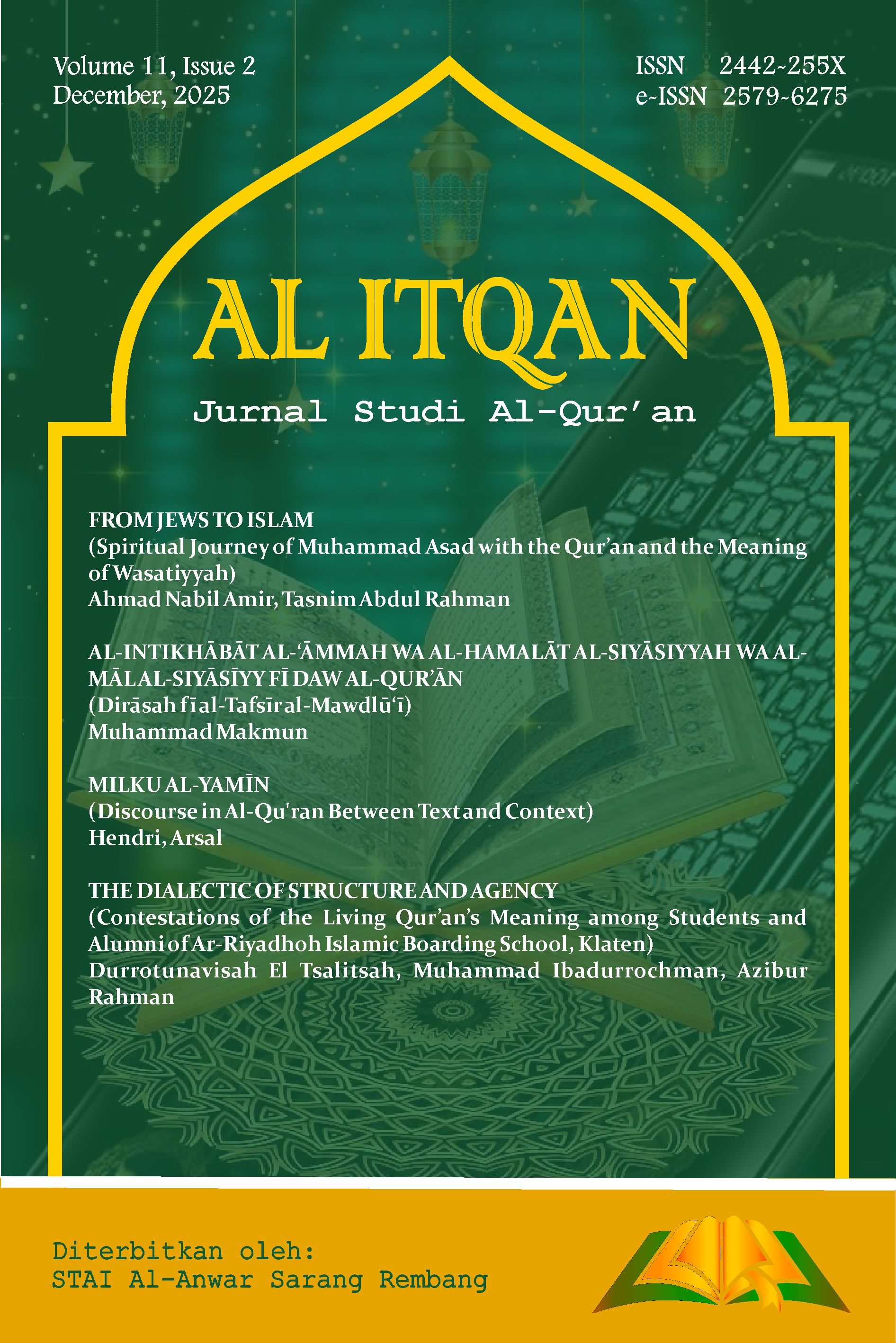
THE DIALECTIC OF STRUCTURE AND AGENCY
Contestations of the Living Qur’an’s Meaning among Students and Alumni of Ar-Riyadhoh Islamic Boarding School, Klaten
DOI:
https://doi.org/10.47454/alitqan.v11i2.1186Keywords:
Living Qur’an, structure-agency, memorization, Islamic boarding, phenomenologyAbstract
Amid rapid socio-cultural change, the sustainability of Qur’anic memorization beyond pesantren walls remains a critical yet underexplored issue in Living Qur’an studies. This research aims to examine how structural systems shape memorization practices, how actors construct the meaning of Living Qur’an, and how structure–agency contestation emerges in post-pesantren contexts. Employing a qualitative phenomenological design, data were collected through in-depth interviews with students, alumni, and teachers, and analyzed using thematic coding and comparative matrix analysis to identify essential patterns. Findings reveal a direct relationship between institutional structure (scheduled muroja’ah, sima’an partnership, layered evaluation) and the stability of memorization practices within the pesantren. However, an indirect effect occurs when a strong structural dependency weakens self-regulation, resulting in diminished continuity after graduation. The rhetoric–practice gap further shows that “living” the Qur’an is frequently reduced to ritual preservation rather than ethical transformation. Implications highlight the need for transition-oriented pedagogy that gradually shifts external control toward autonomous agency without overstating rejected assumptions about structural rigidity. The study contributes theoretically by advancing an ecological-structurational framework, integrating Bourdieu’s habitus and Giddens’ structuration theory to reconceptualize Living Qur’an as a dynamic interaction between system and actor.
Downloads
References
Abdurrahman, Landy Trisna. “Moderatisme Sebagai Konsep Berkehidupan Bersama Dalam Perspektif Tafsir Al-Qur’an Kontemporer.” SUHUF 15, no. 1 (2022): 21–42. https://doi.org/10.22548/shf.v15i1.692.
Andreanto, Muhammad Rifqi, Eka Prasetiawati, dan Muhamad Agus Mushodiq. “Tradisi Mujahadah Usbu’iyah Di Pondok Pesantren Raudlatul Qur’an Metro Lampung (Studi Living Qur’an).” Journal of Islamic Scriptures in Non-Arabic Societies 1, no. 2 (2024): 101–18. https://doi.org/10.51214/jisnas.v1i2.947.
Argyris, Chris, dan Donald A. Schon. Theory in Practice: Increasing Professional Effectiveness. John Wiley & Sons, 1992.
Assegaf, Muhammad Afif. “Pembacaan Dzikir Ratib Al-Attas Dan Al-Haddad Di Pesantren Modern Al-Qur’an Pekalongan: Studi Living Qur’an.” Journal of Islamic Scriptures in Non-Arabic Societies 1, no. 1 (2024): 76–87. https://doi.org/10.51214/jisnas.v1i1.776.
Auliyah, Iqna, Ris’an Rusli, dan Totok Agus Suryanto. “Kajian Living Qur’an Atas Pembentukan Keluarga Islami Dalam Tafsir Al-Misbah.” Living Islam: Journal of Islamic Discourses 7, no. 2 (2024): 279–302. https://doi.org/10.14421/lijid.v7i2.5646.
Bandura, A., dan Prentice Hall. Albert bandura and social learning theory. NJ: Prentice Hall, 1977.
Berger, Peter, dan Thomas Luckmann. “The Social Construction of Reality.” Dalam Social Theory Re-Wired, 2 ed. Routledge, 2016.
Bourdieu, Pierre. “Outline of a Theory of Practice.” Dalam The New Social Theory Reader, 2 ed. Routledge, 2008.
Creswell, John W., dan Cheryl N. Poth. Qualitative Inquiry and Research Design: Choosing Among Five Approaches. SAGE Publications, 2016.
Darmawan, Eko. “Perkembangan Tafsir Di Indonesia Kontemporer.” Mashadiruna Jurnal Ilmu Al-Qurân Dan Tafsir 3, no. 2 (2024): 101–8. https://doi.org/10.15575/mjiat.v3i2.25310.
Deci, Edward L., dan Richard M. Ryan. Intrinsic Motivation and Self-Determination in Human Behavior. Springer Science & Business Media, 2013.
Erlina, Lira, Sabrur Rahma, Rusyda Albahiy, dkk. “Peningkatan Kualitas Bacaan Al Qur’an Melalui Kegiatan Tahsin di Pondok Pesantren Putri Al Ikhlash Jember.” Zad Al-Ummah: Jurnal Pengabdian Masyarakat 3, no. 1 (2025): 74–84. https://doi.org/10.55759/zau.v3i1.36.
Fatah, Nasrul, Syarifah Laili, dan Hidayatullah Ismail. “Living Qur’an; Implementasi Pengamalan Ayat-Ayat Menyantuni Anak Yatim Masjid Paripurna.” Madania: Jurnal Ilmu-Ilmu Keislaman 13, no. 2 (2023): 137–44. https://doi.org/10.24014/jiik.v13i2.25059.
Fauziah, Lu’luatul, Altaf Abdurrohman, dan Hikmatul Lutfi. “Living Quran Di Era Digital: Analisis Praktik Tadarus Online Selama Ramadhan Pada Platform Internet: Penelitian.” Jurnal Pengabdian Masyarakat Dan Riset Pendidikan 4, no. 1 (2025): 656–61. https://doi.org/10.31004/jerkin.v4i1.1644.
Foucault, Michel. “‘Panopticism’ from ‘Discipline & Punish: The Birth of the Prison.’” Race/Ethnicity: Multidisciplinary Global Contexts 2, no. 1 (2008): 1–12.
Freire, Paulo. “Pedagogy of the Oppressed*.” Dalam Toward a Sociology of Education. Routledge, 1978.
Geertz, Clifford. The Interpretation Of Cultures. Basic Books, 1973.
Gershuny, Jonathan. Changing Times: Work and Leisure in Postindustrial Society. Oxford University Press, 2003.
Goffman, Erving. “The Presentation of Self in Everyday Life.” Dalam Social Theory Re-Wired, 3 ed. Routledge, 2023.
Hermann, Ebbinghaus. Memory: A contribution to Experimental Psychology. Teachers College, 1913.
Holland, Dorothy. Identity and Agency in Cultural Worlds. Harvard University Press, 2001.
Huberman, AMMB. Qualitative data analysis a methods sourcebook. 2014.
Huda, Nur, Ahmad Habiburrohman Aksa, Ahmad Musonnif Alfi, dan Faridlatus Sya’adah. “Tradisi Muqaddaman di Desa Banjaragung Kecamatan Bangsri Kabupaten Jepara: Sebuah Kajian Living Qur’an.” AL QUDS : Jurnal Studi Alquran dan Hadis 6, no. 1 (2022): 1. https://doi.org/10.29240/alquds.v6i1.3307.
Huda, Nur, dan Athiyyatus Sa’adah Albadriyah. “Living Quran: Resepsi Al-Qur’an Di Pondok Pesantren Al-Husna Desa Sidorejo Pamotan Rembang.” Al-Munqidz: Jurnal Kajian Keislaman 8, no. 3 (2020): 358–76. https://doi.org/10.52802/amk.v8i3.266.
Husna, Rifqatul. “Program Majelisan Dalam Meningkatkan Kualitas Hafalan (Studi Living Qur’an Di Pusat Pendidikan Ilmu Al-Qur’an Pondok Pesantren Nurul Jadid Paiton Probolinggo).” Hamalatul Qur’an : Jurnal Ilmu Ilmu Alqur’an 2, no. 2 (2021): 35–45. https://doi.org/10.37985/hq.v2i2.19.
Husna, Sayidatul Husna Panjaitan, dan Muhammad Aufal Minan. “Implementasi Tradisi Wirid Yasin (Yasinan) Di Desa Kota Bangun Sebagai Kajian Living Al-Qur’an.” Indonesia Islamic Education Journal 2, no. 1 (2023): 47–56. https://doi.org/10.37812/iiej.v.2i1.782.
Jailani, dan Ahmad Thobroni. “Living Quran sebagai Wadah Baru dalam Penelitian Tafsir.” MAHAD ALY JOURNAL OF ISLAMIC STUDIES 1, no. 1 (2025): 99–113. https://doi.org/10.63398/jsimahadaly.v1i1.16.
Lave, Jean, dan Etienne Wenger. Situated Learning: Legitimate Peripheral Participation. Cambridge University Press, 1991.
Mahfud, Mahfud alizar. “Metode Living Qur’an Sebagai Penanganan Masalah Dalam Lingkungan Masyarakat.” SALIHA: Jurnal Pendidikan Islam 6, no. 2 (2023): 336–54. https://doi.org/10.54396/saliha.v6i2.650.
Ni’mah, Ulviyatun. “The Living Qur’an: Self-Healing dengan Ayat-ayat al-Qur’an.” Al-Manar: Jurnal Kajian Alquran Dan Hadis 8, no. 2 (2022): 65–88.
Ningsih, Tiara, Khalisa Nurul Fitri Arfan, dan Laila Sari Masyhur. “Living Qur’an: Sebuah Pendekatan Kontekstual dalam Memahami Al-Qur’an.” Journal Hub for Humanities and Social Science 2, no. 1 (2025): 116–26. https://doi.org/10.63847/3e2cyc59.
Nuraini, Nuraini, Waharjani Waharjani, dan Mohammad Jailani. “From Textual to Contextual: Contemporary Islamic Thinker Abdullah Saeed on Qur’anic Exegesis.” Jurnal Ilmiah Al-Mu’ashirah 21, no. 1 (2024): 32–49. https://doi.org/10.22373/jim.v21i1.19639.
Putnam, Robert D. Bowling Alone: The Collapse and Revival of American Community. Simon and Schuster, 2000.
Rahmawati, Adelia, Ngulya Nadhifa, dan Indah Rahmadita. “Living Qur’an Dalam Karya Seni Kontemporer Indonesia: Analisis Lagu’Gala Bunga Matahari’Karya Sal Priadi.” Edu Pustaka: Journal of Education and Religious Studies 1, no. 2 (2024).
Rosanti, Dwi Alma. “Tradisi Yasinan sebagai Living Qur’an di Desa Tropodo Kecamatan Waru.” Jurnal PUBLIQUE 4, no. 1 (2023): 39–48. https://doi.org/10.15642/publique.2023.4.1.39-48.
Salafudin, Ahmad Basith. “Studi Living Qur’an: Tradisi Pembacaan Surat Al-Waqi’ah Di Pondok Pesantren Darul-Falah Tulungagung.” Al-Dzikra: Jurnal Studi Ilmu al-Qur’an Dan al-Hadits 15, no. 1 (2021): 111–38. https://doi.org/10.24042/al-dzikra.v15i1.8378.
Seligman, Martin EP. Learned helplessness: On depression, development, and death. W. H. Freeman, 1975.
Vygotsky, L. S., dan Michael Cole. Mind in Society: Development of Higher Psychological Processes. Harvard University Press, 1978.
Downloads
Published
Issue
Section
License
Copyright (c) 2025 Durrotunavisah El Tsalitsah, Muhammad Ibadurrochman, Azibur Rahman (Author)

This work is licensed under a Creative Commons Attribution-ShareAlike 4.0 International License.