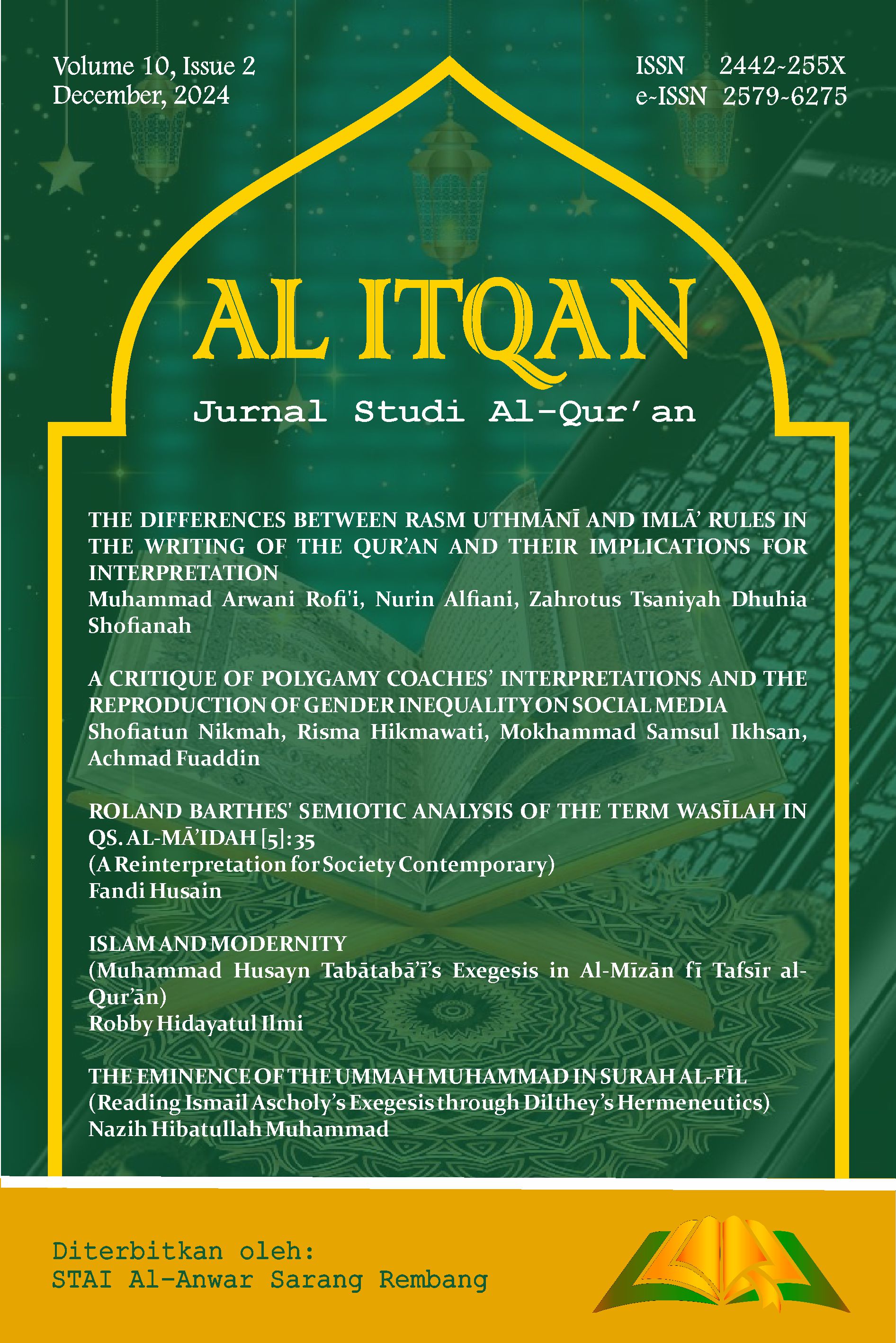
ROLAND BARTHES' SEMIOTIC ANALYSIS OF THE TERM WASĪLAH IN QS. AL-MĀ’IDAH [5]: 35
A Reinterpretation for Society Contemporary
DOI:
https://doi.org/10.47454/alitqan.v10i2.1038Keywords:
Denotation, Connotation, Myth, WasīlahAbstract
The command in Qur’an Surah al-Mā’idah [5]: 35 to pursue a means of attaining proximity to God continues to be a contentious topic among Muslims today. The term wasīlah in this verse has been translated by numerous scholars as qurbah, signifying the act of drawing closer to God by actions that are pleasant to Him. Nonetheless, the text does not delineate the specific actions by which one may attain proximity to Allah. Consequently, an analysis of its language features, contextual background, and modern cultural interpretations is essential for achieving a pertinent understanding. This study seeks to examine the significance of the term wasīlah by concentrating on its linguistic and mythical frameworks. This study utilizes a library research methodology employing a descriptive-analytical framework. The findings reveal that, within the linguistic framework, the term wasīlah is interpreted as an intermediary, pathway, technique, and related connotations. Secondly, given the mythological framework, the significance of wasīlah in QS. al-Mā’idah [5]: 35 as a means of approaching Allah becomes very active. Various methodologies and traditions evidently endorse ritual behaviors, encompassing not only required deeds but also those imparted by spiritual wayfarers (sulūk) who hold specific spiritual ranks (maqām) before Allah, with the objective of achieving His pleasure. This study presents a methodological contribution through a semiological reading model (denotation–connotation–myth) applied to a contentious Qur’anic phrase, which may act as a reference framework for the analysis of other terms in contextual Qur’anic interpretation.
Downloads
References
‘Abdul Baqi, Muhammad Fuad. Mu’jam al-Mufahras li Alfāẓ al-Qur’anul Karīm. Dar al-Fikr, 1992.
Adiansyah, Ridho, Adib Sofia, Muin Bensar, Ali Adams, dan Mohamed Ahmed Barakat. “Roland Barthes Semiotic Study: Understanding The Meaning Word Of’Azab, A Reinterpretation For Modern Society.” QiST: Journal of Quran and Tafseer Studies 2, no. 3 (2023): 255–74. https://doi.org/10.23917/qist.v2i3.1445.
Al-Qur’an, Lajnah Pentahsihan. Al-Qur’an dan Terjemahannya Edisi Penyempurnaan 2019. Lajnah Pentashihan Mushaf Al-Qur’an Balitbang Diklat Kemenag RI, 2019.
Al-Qurtubi, Abdillah Abi Bakrin. al-Jami’ Li Ahkam al-Qur’an. Mu’ assasah al-Risalah, 2006.
Al-Tabari, Abi Ja’far Muhammad Ibn Jarir. Jami’ al-Bayan ’an Ta’wil ay al-Qur’an. Dar al-Hadits, 2010.
Al-Zuḥailī, Wahbah Ibn Muṣṭāfā. Al-Tafsīr Al-Munīr. Vol. 19. Dār al-Fikr al-Mu’āṣir, 1997.
Aman, Moh. “Kurikulum Pendidikan Berbasis Al-Qur’an.” Rausyan Fikr: Jurnal Pemikiran Dan Pencerahan 16, no. 1 (2020): 1–14. https://doi.org/10.31000/rf.v16i1.2418.
Badriyah, Lailatul. “Ayat-ayat Tawasul dalam Perspektif Muhammad bin Abdul Wahab.” UIN Walisongo, 2009.
Barthes, Roland. Mythologies. The Noonday Press, 1991.
Bruckmayr, Philipp. “Salafī Challenge and Māturīdī Response: Contemporary Disputes over the Legitimacy of Māturīdī kalām.” Die Welt des Islams 60, no. 2–3 (2020): 293–324. https://doi.org/10.1163/15700607-06023P06294.
Culler, Jonathan D. Ferdinand de Saussure. Cornell University Press, 1986.
Farih, Amin. “Paradigma Pemikiran Tawassul Dan Tabarruk Sayyid Ahmad Bin Zaini Dahlan Ditengah Mayoritas Teologi Madzhab Wahaby.” Jurnal Theologia 27, no. 2 (2016): 279–304. https://doi.org/10.21580/teo.2016.27.2.1069.
Hielmina, Suad, Nur Huda, dan Fitri Febriyanti. “Penafsiran Al-Qur’an Metode Tembang Jawa Gus Ali Purwodadi Perspektif Semiotika Roland Barthes.” AL ITQAN: Jurnal Studi Al-Qur’an 7, no. 1 (2021): 1–30. https://doi.org/10.47454/itqan.v7i1.744.
Ibnu Kathīr al-Qurashī al-Dimashqī, Abū Fidā` Ismā’īl bin ‘Umar. Tafsῑr al-Qur`an al-Aẓῑm. Vol. 1. Dār Ṭaibah, 1999.
Jabbar, M. Dhuha Abdul, dan Burhanudin. Ensiklopedia Makna Al-Qur’an Syarah Alfaazhul Qur’an. Media Fitrah Rabbani, 2012.
Katsir, Ibn. Tafsir al-Qur’an al-’Adzim. Dar al-Tayyibah, 1999.
Kellner, Martin. “Visiting the Prophet at His Grave: Discussions about the Religious Topography of Madina.” Religions 15, no. 5 (2024): 552.
Khadal, Fatimah Binti Abdul. “Konsep Tawassul menurut perspektif. Al-Qur’an.” Thesis, UIN Syekhnurjati, 2019.
Kreinath, Jens. “Playing with frames of reference in veneration rituals: Fractal dynamics in encounters with a Muslim saint.” Anthropological Theory 20, no. 2 (2020): 221–50. https://doi.org/.%2520Sheikh,%2520Naveed%2520S.%2520“Pax.
Lukman, Fadhli. “Digital Hermeneutics and A New Face of The Quran Commentary: The Quran in Indonesians Facebook.” Al-Jami’ah: Journal of Islamic Studies 56, no. 1 (2018): 95–120. https://doi.org/10.14421/ajis.2018.561.95-120.
Mulyati, Farihatni. “Makna Wasilah Dalam Surah Al Maidah Ayat 35 Dan Surah Al Isra’Ayat 57.” Kopertais Wilayah XI Kalimantan 14, no. 25 (2016): 61–77. https://doi.org/10.18592/ittihad.v14i25.864.
Munawwir, Ahmad Warson. Al-Munawwir Kamus Arab-Indonesia. Pustaka Progressif, 1997.
Mustaqim, Abdul. “The Epistemology of Javanese Qur’anic Exegesis: A Study of Ṣāliḥ Darat’s Fayḍ al-Raḥmān.” Al-Jami’ah: Journal of Islamic Studies 55, no. 2 (2017): 357–90. https://doi.org/10.14421/ajis.2017.552.357-390.
Nur, Faisal Muhammad. “Konsep Tawassul Dalam Islam.” Substantia: Jurnal Ilmu-Ilmu Ushuluddin 13, no. 2 (2011): 267–73. https://doi.org/10.22373/substantia.v13i2.4830.
Saeed, Abdullah, dan Ali Akbar. “Contextualist Approaches and the Interpretation of the Qur’ān.” Religions 12, no. 7 (2021): 527. https://doi.org/10.3390/rel12070527.
Sheikh, Naveed S. “Pax Wahhabica Revisited: Saudi Arabia’s Imperial Theopolitics from Hegemony to Hybridity.” Religions 16, no. 10 (2025): 1286. https://doi.org/10.3390/rel16101286.
Shihab, M. Quraish. Kosakata Keagamaan: Makna dan Penggunaannya. Cet. 1. Disunting oleh Mutimmatun Nadhifah. PT. Lentera Hati, 2020.
Shihab, M. Quraish. Membumikan al-Qur’an: Memfungsikan Wahyu dalam Kehidupan. Cet. 1. Disunting oleh Abd. Syakur DJ. Lentera Hati, 2011.
Shihab, M. Quraish. Tafsir Al-Mishbah: Pesan, Kesan dan Keserasian Al-Qur’an. 5 ed. Vol. 11. Lentera Hati, 2012.
Umaroh, Dewi. “Makna’Abasa Nabi Muhammad Dalam Al-Qur’an (Aplikasi Semiotika Roland Barthes Terhadap QS’Abasa [80]: 1).” Al-Bayan: Jurnal Studi Ilmu Al-Qur’an dan Tafsir 5, no. 2 (2020): 122.
Wijaya, Aksin. Arah Baru Studi Ulumul al-Qur’an. IRCISOD, 2020.
Wijaya, Roma. “Makna Syifa dalam al-Qur’an (Analisis Semiotika Roland Barthes pada QS al-Isra 82): The Meaning of Shifa in the Qur’an (Roland Barthes’ Semiotics Analysis on QS al-Isra 82).” Al-Adabiya: Jurnal Kebudayaan Dan Keagamaan 16, no. 2 (2021): 185–96. https://doi.org/10.37680/adabiya.v16i2.924.
Zakiy, Ahmad. “Analisis Semiologi Roland Barthes atas Terminologi Quwwah dalam QS. Al-Anfal [80]: 60.” Jurnal Media Akademik (JMA) 2, no. 1 (2024): 1565–84.
Downloads
Published
Issue
Section
License
Copyright (c) 2024 Fandi Husain (Author)

This work is licensed under a Creative Commons Attribution-ShareAlike 4.0 International License.